Directive 001 Released
Castle Bravo: The H-Bomb That Came Out Two and a Half Times Too Big
The scientists expected six megatons. They got fifteen. What the declassified files say about the worst radiological disaster in U.S. testing history.
The narration
0:00 The letter
On January 21, 1954, a one page letter left the Atomic Energy Commission in Washington. Presidential approval has been received, it said, for executing CASTLE with March 1, 1954 as the starting date. Below that, a list of materials they were cleared to use. That list is still blacked out. Six weeks later, on a coral atoll in the middle of the Pacific, the first of those devices went off. It was supposed to be six megatons. It was 15. And by the time the ash stopped falling, it had landed on children a hundred miles away, on a fishing boat that was nowhere near the danger zone, and on the reputation of the men who swore they had it under control. This is Directive 001, Castle Bravo.
0:56 A bomb you could drop
To understand Bravo, you have to go back sixteen months. November 1952. The United States sets off the first true hydrogen bomb, a test called Ivy Mike. It works. It erases an entire island. But Ivy Mike was not a weapon. It was a building. 82 tons of machinery, most of it refrigeration because its fuel was liquid hydrogen, chilled to a few degrees above absolute zero. You could not put it on a plane. You could not put it on anything. Meanwhile, the Soviet Union was racing toward its own. Washington needed a hydrogen bomb that could fly. The answer was a powder. Lithium deuteride. A dry, stable salt that would make its own fusion fuel at the moment of detonation. No refrigerators, no tanks, just a steel casing about 15 feet long. They called the first one Shrimp.
2:03 The math
Here is the part the whole story turns on. Natural lithium comes in two forms, lithium six and lithium seven. The designers knew lithium six would feed the reaction. Lithium seven, they believed, would mostly sit there. Inert, along for the ride. So when they ran the numbers for Shrimp, they counted only on the lithium six. Their best estimate was six megatons. Six megatons is already 400 Hiroshimas. They were comfortable with that. Bikini
2:41 The morning
Atoll, the Marshall Islands, the last days of February. The task force is in its place, ships, aircraft, thousands of personnel. The firing crew sits in a concrete bunker on an island called Enyu, about 20 miles from the device. The night before the shot, the weather briefing came in. The winds high above the atoll were shifting. At some altitudes, they could carry the cloud east toward inhabited islands. The test went ahead. March 1, 06:45 in the morning, the firing signal goes out. Within
3:22 Fifteen megatons
One second, the fireball is nearly four and a half miles wide. In the bunker on Enyu, 20 miles away, the building sways and it keeps going. The mushroom cloud punches through the sky. In about ten minutes, it is more than 25 miles high and still spreading. Where the bomb stood, there is now a crater more than a mile across. The instruments come back. The number is 15 megatons, two and a half times the prediction, the largest explosion the United States has ever created to this day. And the reason is the ingredient nobody was watching, lithium seven. Hit hard enough by the neutrons inside the blast, it does not sit still. It breaks apart, and in breaking apart, it makes more fuel. The bomb was carrying far more fuel than its designers thought it had. The mistake was in the math.
4:27 Bikini snow
The blast tore up millions of tons of coral reef and lifted it into the cloud. Coral is mostly calcium. Superheated, it turned into a fine white powder, and that powder was now carrying the radioactive remains of the bomb. The wind did exactly what the briefing said it might. It carried the cloud east. About six or seven hours after the shot, the powder started coming down on Rongelap Atoll, more than a hundred miles from ground zero. It fell like snow. It stuck to the skin and hair. It settled into the water tanks. The children of Rongelap had never seen snow. They played in it. Nobody came for them that day, or the next. It took about two days before the U.S. Navy evacuated the people of Rongelap. By then, many had burns on their skin. Some were losing their hair.
5:27 The Lucky Dragon
80 miles east of Bikini, a Japanese tuna boat was fishing outside the danger zone the United States had declared. Her name was Daigo Fukuryū Maru. In English, Lucky Dragon number five. 23 men aboard. Before dawn, the crew saw the western sky light up. Some of them thought the sun was rising in the wrong place. Minutes later, the sound arrived. Then hours later, the ash. It covered the deck. The men swept it up with their bare hands. They sailed home to Japan, two weeks at sea, getting sicker by the day. When they reached port, the story broke, and it broke everywhere. Radioactive tuna, panic at the fish markets, a country that had already lived through two atomic bombings, now asking how many more it would take. The radio operator was a man named Aikichi Kuboyama. He died on September 23, 1954. He was 40 years old. Six weeks after his death, a film opened in Japanese theaters about a monster awakened by hydrogen bomb tests in The Pacific. It was called Godzilla.
6:43 The official version
So what did the government say? Days later, the Atomic Energy Commission put out a short statement. It said that 28 American personnel and 236 residents had been moved from nearby atolls according to plan as a precautionary measure, that they had been unexpectedly exposed to some radioactivity. And then, there were no burns. All are reported well. In 1955, the United States paid Japan $2,000,000, not compensation. The agreement was careful to say so, an ex gratia payment. In 1957, the people of Rongelap were told their island was safe and they went home. They lived there for nearly thirty years, eating food from contaminated soil. In 1985, they left again on their own, carried off by a Greenpeace ship called the Rainbow Warrior.
7:45 What the files show
The government filmed all of it, hours of it. The bunkers, the ships, the cloud, the charts where the fallout was acceptable. Decades later, the Department of Energy released that film to the public. At the very start, there is the title card. This video has been sanitized. Classified portions have been removed. Seventy years on, the letter that started it all still has its list of materials blacked out. The film still has its gaps, and somewhere in those gaps is the rest of the story. The government's own files tell us this much. We'll keep reading. This has been Directive 001. If you want the next file when it's released, subscribe. Next time, a dead Soviet submarine three miles down and the CIA's plan to steal it.
The files
-
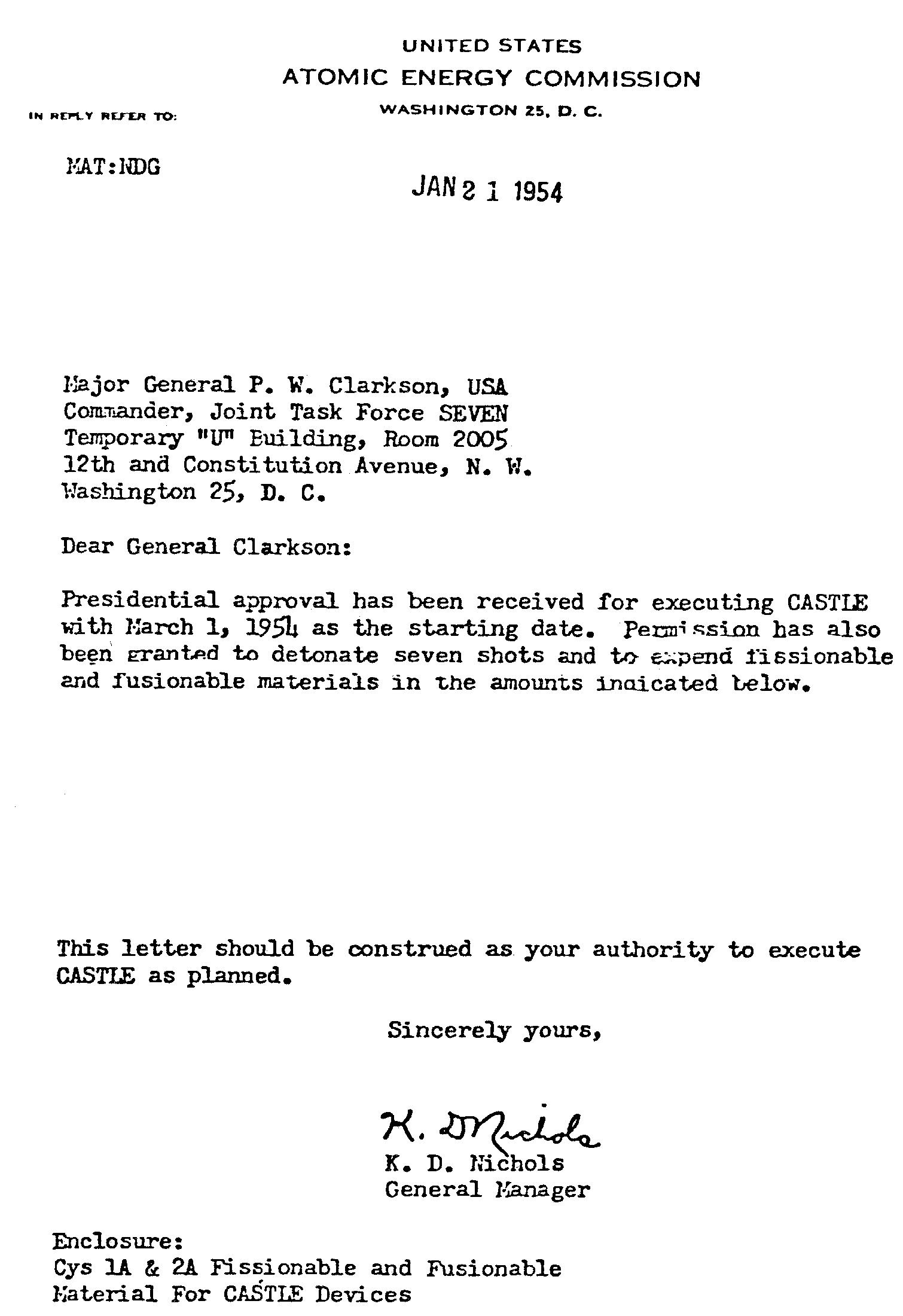 AEC authorization for Operation Castle
U.S. Atomic Energy Commission, 21 January 1954. Presidential approval to begin Castle on 1 March 1954; the material amounts are withheld.
-
Operation Castle film report
Joint Task Force 7 / Lookout Mountain Laboratory. Released by the Department of Energy as a sanitized film: "classified portions have been removed."
-
Castle Bravo fallout contours
U.S. government map of the fallout pattern east of Bikini, with Rongelap, Rongerik and Utirik atolls.
-
Department of Energy OpenNet
The DOE's public archive of declassified nuclear testing documents.


Questions people ask
How big was Castle Bravo?
Castle Bravo yielded 15 megatons, about two and a half times the 6 megatons its designers predicted. It remains the largest nuclear device the United States has ever tested.
Why was Castle Bravo bigger than expected?
The device used lithium deuteride fuel. Designers assumed only the lithium-6 in it would contribute, but the more common lithium-7 also reacted, producing extra fusion fuel and a far larger blast.
What happened to the people of Rongelap?
Fallout landed on inhabited atolls east of Bikini, including Rongelap, more than a hundred miles away. Residents were exposed for about two days before they were evacuated.
What happened to the Lucky Dragon?
The Japanese fishing boat Daigo Fukuryū Maru (Lucky Dragon No. 5) was about eighty miles away and was covered in fallout. Its radio operator, Aikichi Kuboyama, died on 23 September 1954.
Discussion
The conversation for this directive happens under the video. Join it on YouTube.